
Key Points:
• Australian house prices are again falling following investor tax changes in the budget and a renewed RBA hiking cycle.
• Moderate falls in home prices are common and have done little to address the relentless rise over the past fifty years.
• There have been more meaningful corrections in housing overseas, driven by significantly negative macro conditions, extreme policy tightening cycles and population declines.
• Australian prices had been supported since 2022 by strong population growth and an increase in the replacement cost of assets despite increasing rates.
• A large correction in prices would require active decisions by the Government, particularly on the overseas migration front which has kept the housing market in shortage since the borders reopened after Covid.
Fire up the barbecue chat; Australian home prices are falling again. Although it is often headline news (bizarrely, newspapers write articles about the outcome of individual property sales every week), minor falls in home prices are relatively common. In this month’s Market Insight, we review the housing market and consider whether this time around price falls could be more major than minor. Home price corrections in Australia normally cap out at around 10%. Despite these occasional corrections, the rise in home prices has been relentless and has taken Australian home values to amongst the highest in the world relative to incomes.
Corrections for Ants
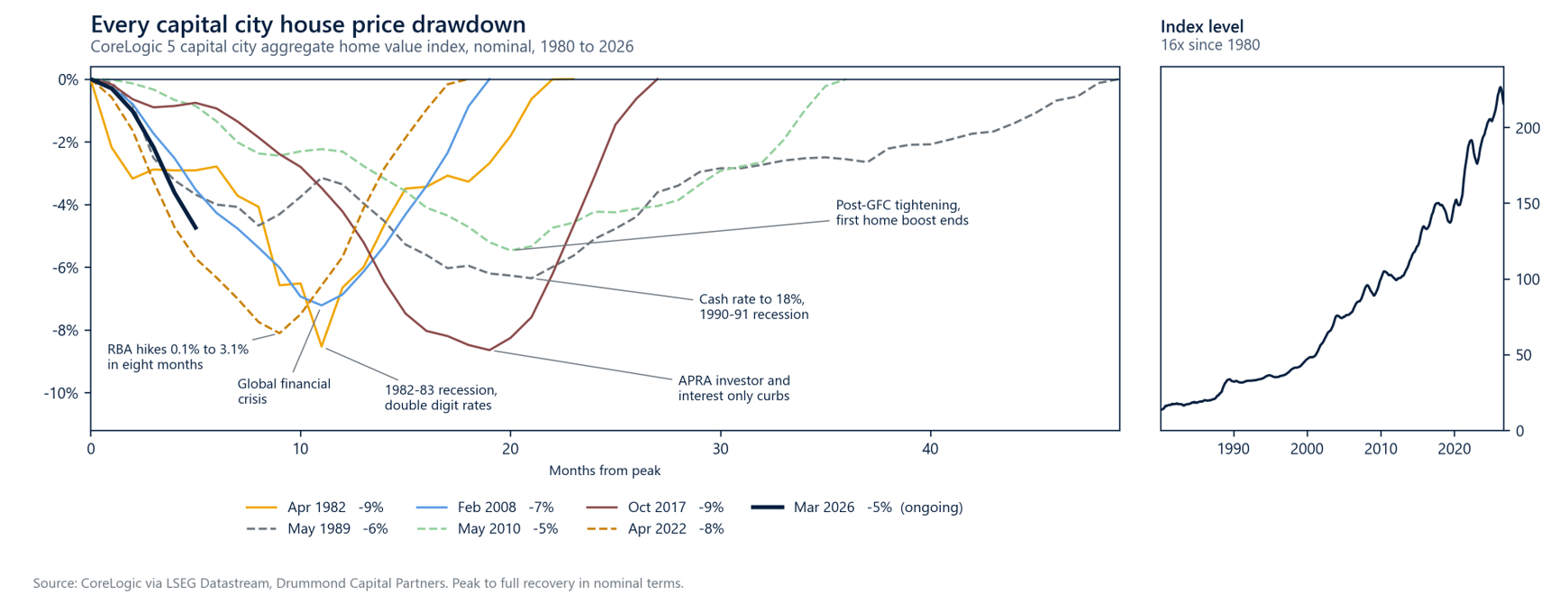
Since the early 1980s, there have been seven periods where national house prices have fallen by more than five percent. Over this period, the price of the median home has risen around 16-fold. However, disposable household income has only risen ~eight-fold. Interest rates have fallen, but nowhere near enough to compensate for the price level increases, meaning first home buyers are currently slugged a higher percentage of their income, for a longer period, than any other generation.
Previous slowdowns have been driven by a handful of recurring factors. Rate hiking cycles make housing more expensive to finance. Tighter prudential regulation limits how much buyers can borrow. Weaker economic conditions push unemployment up and prompt banks to tighten lending on their own accord. Sometimes more than one of these arrives at once.
Working backwards: the 2022 fall followed the sharpest rate hiking cycle in decades. Between 2015 and 2017, APRA progressively tightened lending standards, particularly for investors and interest only borrowers, and prices fell around 9%. Prices fell 5% in 2010 as the RBA normalised rates after the Financial Crisis, and 7% during the Financial Crisis itself. The "recession we had to have" took prices only 6% lower, despite the unemployment rate rising more than five percentage points. The early 1980s hiking cycle and recession saw a 9% fall.
Are Investors Crazy?
The current correction is being driven by a renewed interest rate hiking cycle and by changes to the taxation arrangements announced in the latest Budget which limited negative gearing to new builds and replaced the 50% CGT discount with cost base indexation and a 30% minimum tax on gains. Markets expect a little more hiking by the RBA, but the expected hikes are fine tuning rather than trying to dramatically slow the economy, so we expect limited transmission from that channel to prices. It is really the Budget changes which are of most interest. There are two schools of thought here with respect to impact:
• Based on the body of research from the RBA, Treasury, the Grattan Institute and academic economists on the impact of investor tax concessions on house prices, the changes should have a limited impact, with most estimates sitting between 1% and 4% lower than the counterfactual. CGT changes are economy wide, so shouldn’t on their own drive switching between asset classes for investors. The negative gearing changes still allow losses to be carried forward and deducted against future rental income or property capital gains
• The second point of view is that only an insane person would buy an established home now as an investment property in Australia given a sub-3% gross rental yield, extreme unaffordability and the loss of the ability to deduct losses against employment income.
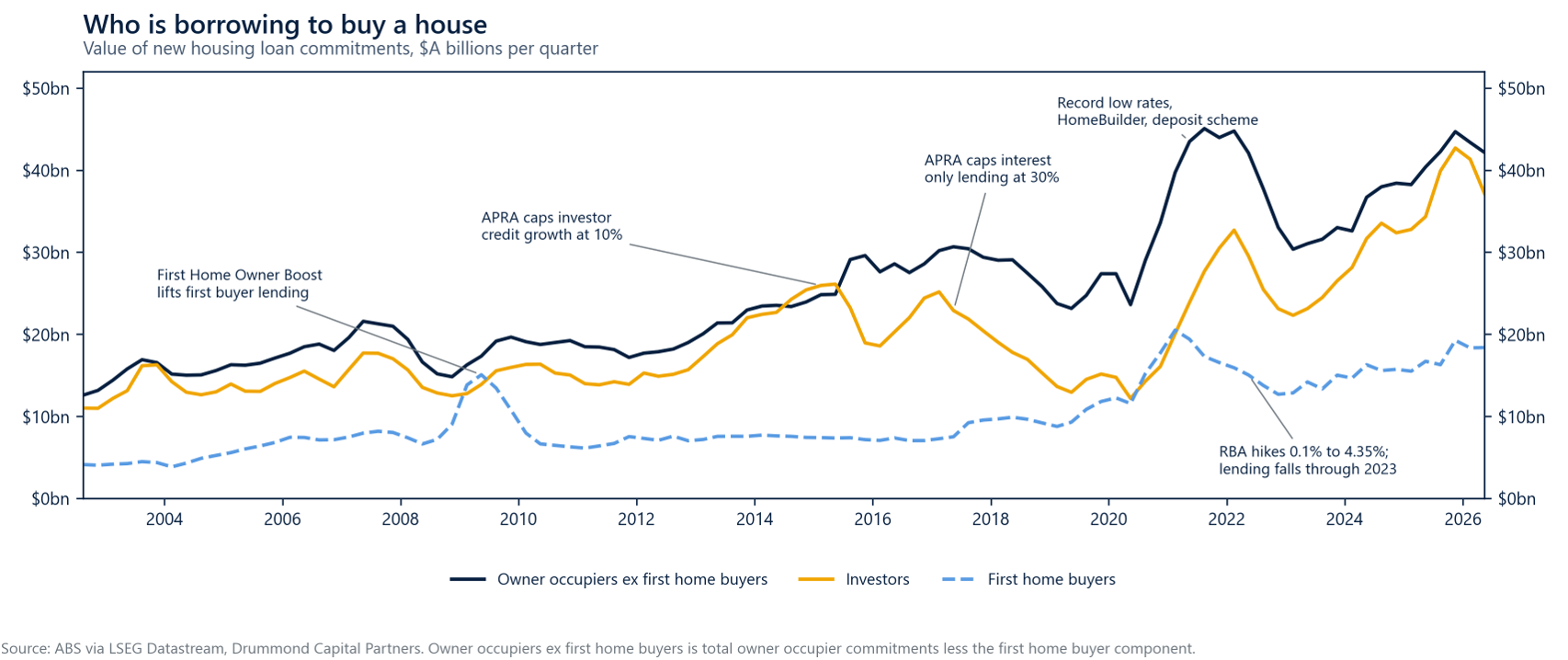
Traditionally, investors have been extremely active in the domestic housing market, borrowing a comparable amount for property purchases every quarter as owner occupiers excluding first home buyers. Around 80% of this investor activity goes towards established (rather than new) housing. If the “insane person” school of thought is correct, up to one third of home purchase activity could disappear from the market. Investor activity did fall significantly post APRA tightening between 2015 and 2017 and was associated with the 9% fall in prices during that period. However, existing investors are grandfathered, no one is being forced to sell. Absent strong evidence to the contrary, we would lean on the side of the research and literature with respect to impact of tax changes on the market. There will be an impact from this, though it’s too soon to say whether it will be in excess of previous episodes.
Why Won’t You Fall?
There are many good reasons why prices have gone up so much over the past fifty years, and why market corrections have been minor. Interest rates generally fell between the 1990s and 2020 while the length of the average mortgage was extended. Thus, every potential purchaser had more borrowing power to throw at the existing housing stock. For most of this period, housing was an extremely tax / government transfer advantaged asset. Gains on your principal place of residence were (and still are) tax free, negative gearing had to have some impact (though perhaps minor), and your dwelling is exempt from the age pension means test. Housing is the only asset class you can lever up 10 times and never expect to receive a margin call. Most politicians own at least one investment property, meaning as a property investor your outcomes are aligned with those who make the rules. House prices have also gone up a lot, and people love chasing past performance (housing doubles every seven years, don’t you know?).
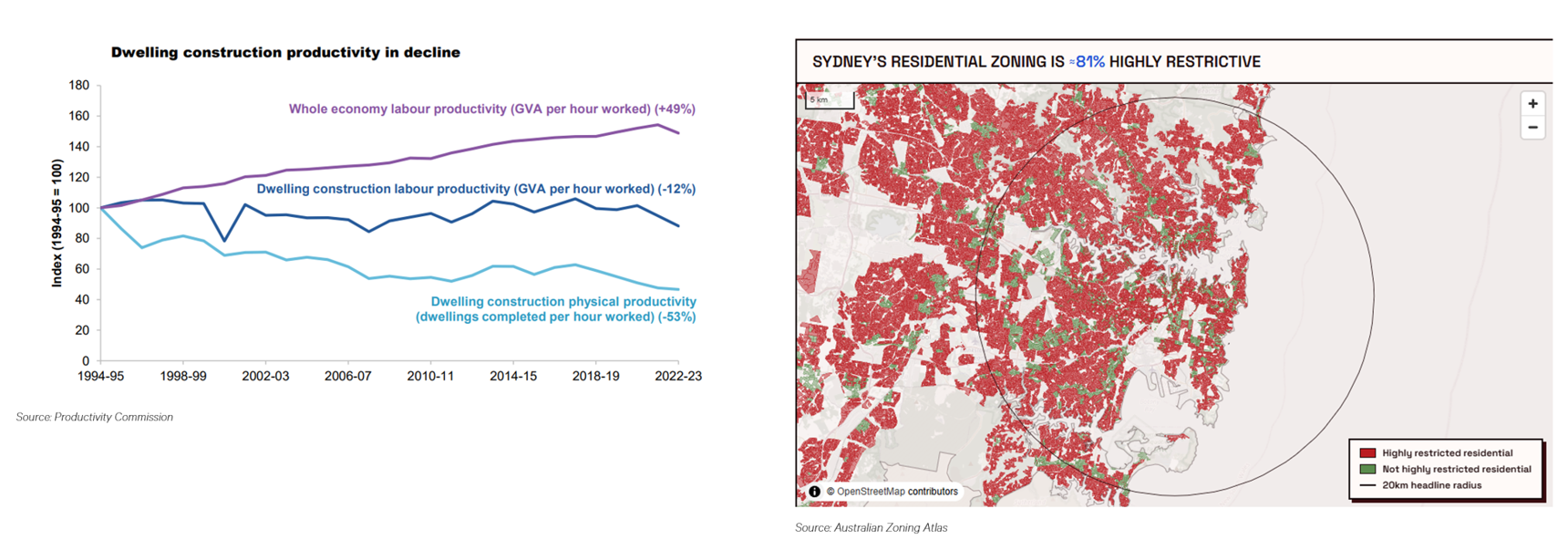
A lack of supply has also driven prices higher. It takes roughly twice as long to build a dwelling now as it did in the mid-1990s (though dwellings are now on average bigger). It has also become increasingly difficult to build new dwellings in Australia. The Productivity Commission argues this is multifaceted. The approval process is fragmented, complex and slow. It can take longer to get a building approved than to actually construct it. Much of the land area in our large cities is restricted to certain types of development (density restrictions) or subjected to some kind of character or heritage overlay (see below right). The construction industry is fragmented with many smaller builders doing the bulk of the work, and innovation across the industry has been lacking versus the rest of the economy.
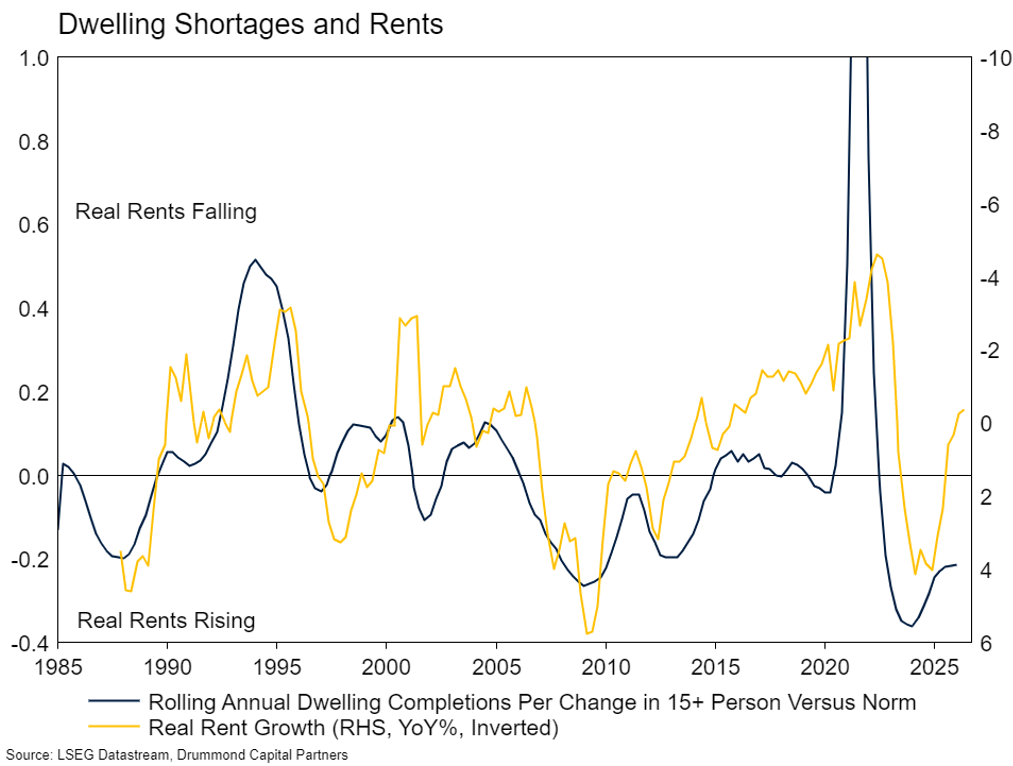
Since 2022, house prices have held up despite the significant increase in interest rates from the RBA for two main reasons. The cost to build a new dwelling has increased by around 40% since 2021, lifting the value of all dwellings sitting on land in the country. The other major factor was the spike in net overseas migration, which continues to be a significant contributing factor to higher home prices. The chart below shows annual dwelling completions relative to the change in population versus real rent growth. In short, when there are lots more people than homes being built, rents and home prices rise. The Australian market has been in severe shortage of housing completions (relative to migration) since 2022.
How Could We Break it?
So, given the above, is the housing market in Australia bulletproof despite being disgustingly expensive? We think given the importance of the value of the housing stock to the economy (a significant fall in house prices should translate into a weaker economy for some period of time due to negative wealth effects driving lower household spending), a substantial fall would have to be facilitated, or at least allowed, by policymakers. The government has a track record of supporting housing via home buyer and builder grants when the market or economy looks shaky. APRA can loosen lending standards at the behest of the government. The RBA will cut rates on substantial weakness if they believe it will negatively impact the economy.
That said, a deliberate policy choice to lower housing prices isn’t unheard of. Punishingly high prices might be good for established households with significant housing wealth, but they structurally impair every generation trying to get into the market beyond that point. Excessive mortgage payments mean less money for other areas of household consumption, and less household saving and investment into productive areas of the economy.
Canada is the clearest recent example. Prices there have fallen around 20% since 2022 in response to the Bank of Canada hiking cycle. Then, under the guise of returning to more sustainable growth, the federal government cut its permanent migration program by around a quarter and let its stock of temporary residents run down, which has translated into an outright decline in population. As a result, the housing market has continued to weaken despite 275 basis points of rate cuts (see below).
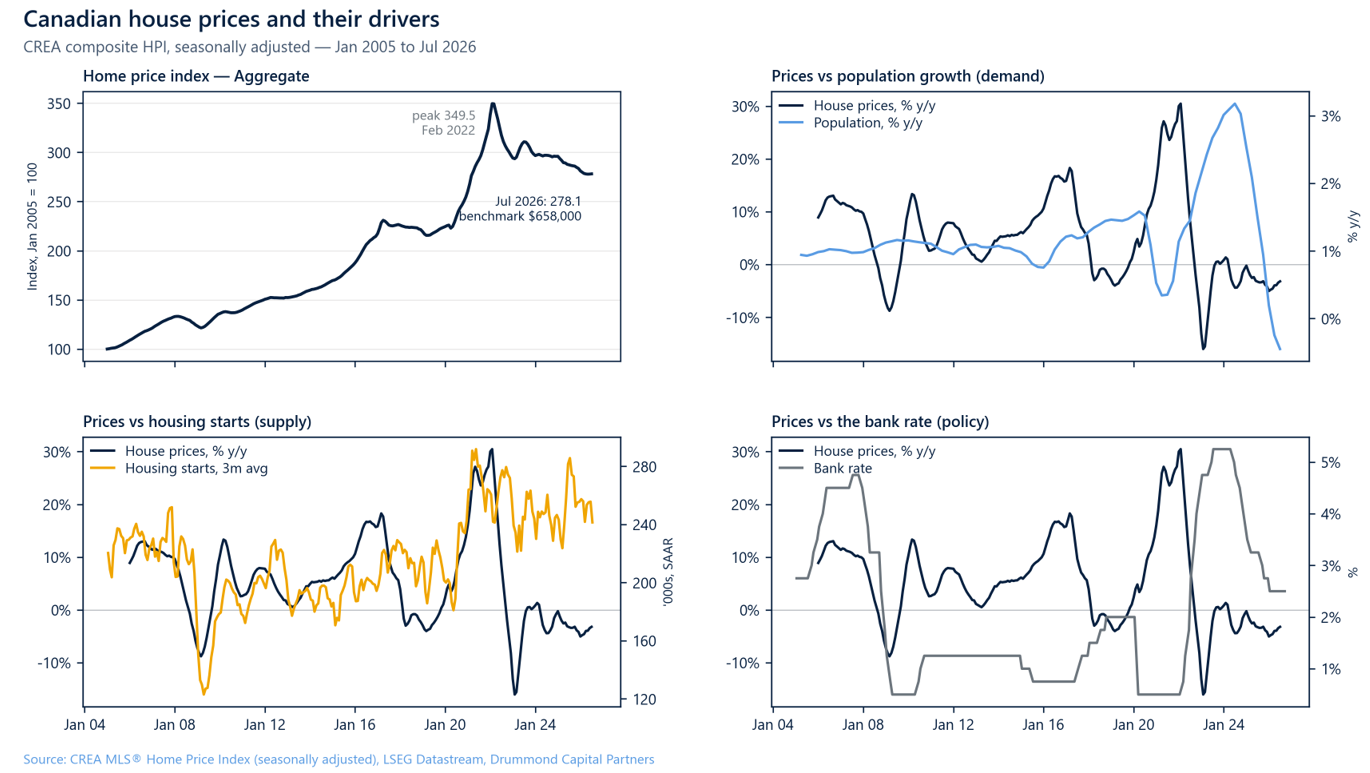
New Zealand is another cautionary tale. Prices there are around 17% below their late-2021 peak in nominal terms and roughly 30% lower in real terms, driven by an aggressive rate hiking cycle, a recession and a collapse in net migration as a record number of New Zealanders left for Australia. House prices, like all prices, are driven by supply and demand, and removing people from the economy is a pretty good way to reduce demand.
It's not unreasonable to imagine a political compact aimed at making housing more affordable. The NSW and Victorian governments overriding local council planning processes is an early example, forcing increased density on residents of wealthy suburbs rather than just the city fringes. Another angle is the general dissatisfaction (outside the higher education and corporate sectors) with very high levels of overseas migration, which is likely to broaden to wealthier electorates once people in Woollahra and the like start getting apartments built next door. With One Nation gaining support in the outer suburbs and breathing down the neck of the major parties, cuts to immigration levels seem likely. This combination of increased supply and lower demand could see pressure on housing prices intensify over and above what the tax changes and higher interest rates are currently delivering. That said, we think the risk of a very material price correction is still low, given the policy levers available to support the market.
Portfolio Positioning
We think part of the structural problem with productivity in the economy could be related to extremely unaffordable housing. Young people cannot afford to live close to where the agglomeration effects (productivity benefit of clustering in cities) are strongest and household savings have been malinvested into housing, which is an unproductive asset. Thus, very high house prices are probably a drag on long term earnings growth. However, falling house prices discourage household consumption and therefore are generally bad for the economy and earnings in the short term. Neither scenario is particularly attractive for Australian equities and this Catch-22 in part supports our current underweight.
Prepared by Drummond Capital Partners (Drummond) ABN 15 622 660 182, AFSL 534213. It is exclusively for use for Drummond clients and should not be relied on for any other person. Any advice or information contained in this report is limited to General Advice for Wholesale clients only.
The information, opinions, estimates and forecasts contained are current at the time of this document and are subject to change without prior notification. This information is not considered a recommendation to purchase, sell or hold any financial product. The information in this document does not take account of your objectives, financial situation or needs. Before acting on this information recipients should consider whether it is appropriate to their situation. We recommend obtaining personal financial, legal and taxation advice before making any financial investment decision. To the extent permitted by law, Drummond does not accept responsibility for errors or misstatements of any nature, irrespective of how these may arise, nor will it be liable for any loss or damage suffered as a result of any reliance on the information included in this document. Past performance is not a reliable indicator of future performance.
This report is based on information obtained from sources believed to be reliable, we do not make any representation or warranty that it is accurate, complete or up to date. Any opinions contained herein are reasonably held at the time of completion and are subject to change without notice.


-p-500.png)