
Key Points:
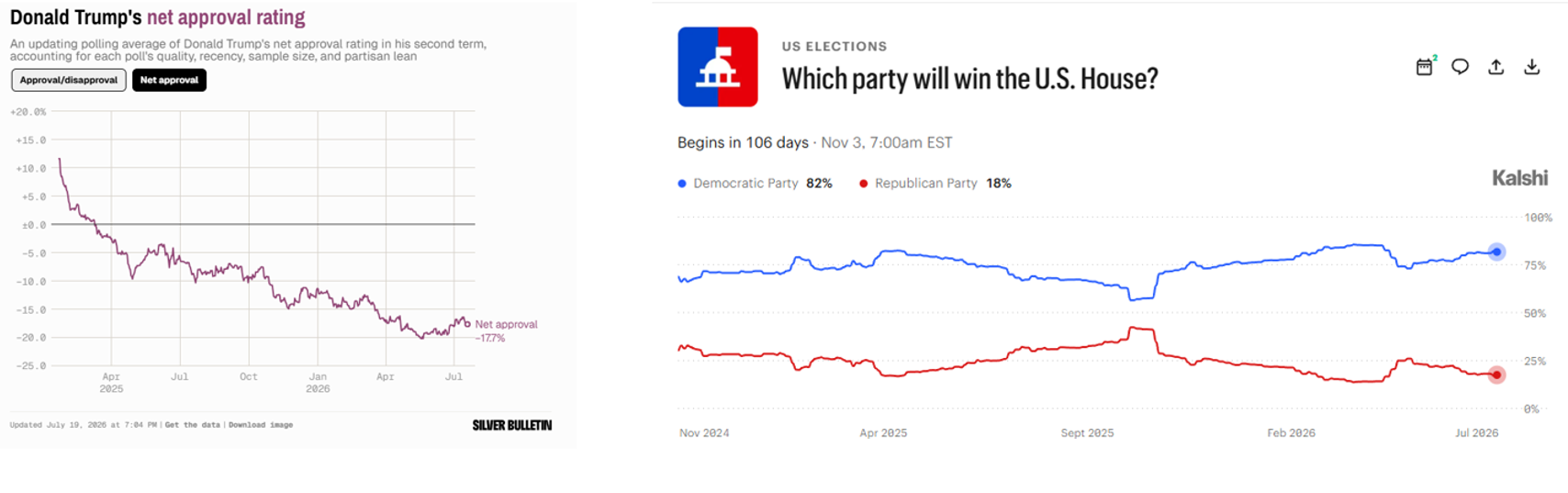
• Polling and betting markets suggest the Republicans are very likely to lose control of the House in November, with around a 40% chance they lose the Senate as well.
• History suggests a divided government is irrelevant for markets. Returns under divided government are statistically indistinguishable from those under unified control. As are returns around midterm election periods.
• Our base case for the final two years of this administration is noisy but more limited government with frequent shutdowns and impeachment news.
• Our portfolios are currently neutral growth exposure, with an underweight to government bonds.
President Trump hasn’t been the boon to markets that many hoped for prior to his election in November 2024. Instead of tax cuts and deregulation, Trump delivered tariffs, Fed uncertainty and war. That said, markets have generally looked through all of this after brief, but sometimes intense, corrections. The structural positivity around AI and solid earnings growth have more than offset the political risk premium. With US voters likely to deliver control of the House and potentially Senate to the Democrats following midterm elections in early November this year, we expect a shifting of the winds. In this month’s Market Insight, we outline what we think the US political environment will look like in the final two years of President Trump’s administration and what that will mean for markets.
Change of Control
Midterms are historically bad for the president’s party. Since the Second World War, the incumbent party has lost an average of around 26 House seats at the midterms, and the losses get bigger when presidential approval is below 50% (Trump is well below that currently). Trump lost 41 House seats in the 2018 midterms during his first term. In line with this, betting markets put around an 80% probability of the Republican party losing control of the House this time around and around a 40% chance of the Republicans losing the Senate. It’s harder for the Democrats to gain control of the Senate because only a third of the Senate is up for election, and few Republican-held seats are competitive this cycle.
Gridlock is Good?
The instinctive reaction to political dysfunction is negative, but historically midterms and divided government haven’t meant much for markets at all. US equities have risen (as is their wont) in the twelve months following every one of the thirteen midterm elections since 1974, with an average return of around 16% (see below). The worst of them (1986) still delivered around 4%. The rally has also been front loaded, with the three months following midterms averaging around 7%, versus 4% following presidential elections. We wouldn’t lean too hard on that as a trading signal as equities rise most years, but it is hard to find any evidence that midterms are something to be feared.

Divided government has a similar outcome. Average equity returns under divided government (around 13% annualised since 1973) are statistically indistinguishable from those under unified control (around 11%). Sometimes a weak government, which can’t change anything materially, is just what the market needs, rather than constant changes in legislation. A strong government can deliver broad structural reform which helps the economy and markets, but they can just as easily regulate an industry into unprofitability. Gridlock means less legislation, less legislation means less policy uncertainty, and markets price uncertainty, not ideology.

Impeach, Impeach, Impeach
So, assuming the Democrats control at least the House, what does 2027 and 2028 look like? In our view, it may represent a reprieve from uncertainty policy. While Republican members of Congress haven’t been a complete pushover for Trump, the check against the more extreme elements of his policy (Fed Chair removal, tariffs) has come from the Supreme Court rather than the legislature. Republicans have been very hesitant to stand up to Trump on executive overreach. That will clearly change next year. Trump won’t get anything controversial legislated, and Democrats in Congress will seek to (probably with mixed success) reverse some of Trump’s executive orders. Democrats will be a clear check against Trump excess. That said, the check is not complete. Much of the administration's most market-relevant policy runs through authority Congress has previously delegated, or in a grey area of uncertain responsibility. A hostile Congress cannot practically overturn orders without a supermajority in both houses, which seems unlikely. Still, it is more constraint on Trump than we have seen in the past two years. The Judiciary has also shown itself to be a solid check in the past two years.
The other major change in tone will be around appropriation (budget) and impeachment. A Democratic House and a Republican White House negotiating appropriations is a recipe for brinkmanship, and we would expect frequent government shutdowns as the base case. There has already been a brief shutdown and a record 76-day partial shutdown this year, even with Republican control. That’s not necessarily something to be extremely concerned about given to date their impact on the economy and markets has been limited. The longest shutdown in history (in late 2025), reduced quarterly GDP by around a percentage point, most of which was recovered once the government reopened. The net effect will probably be a bit of fiscal consolidation, which isn’t really a bad thing given the state of the deficit and relatively strong private sector demand.
A Democratic House will almost certainly open multiple rounds of impeachment proceedings against Trump. Here again, history is reassuring. The market rallied through the Clinton impeachment in 1998 and through both Trump impeachments in his first term. Conviction requires 67 Senate votes, which is a bigger number than the Democrats can achieve. As a result, impeachment proceedings will be political theatre with a foregone conclusion unless Trump does something so egregious even Republicans baulk at it.
Portfolio Positioning
Our portfolios are currently neutral growth exposure. The election base case of a divided Congress and a noisy but constrained administration doesn’t warrant a defensive stance.
The portfolios hold an underweight to government bonds, which will help in any period of fiscal instability as government bonds will likely be the epicentre of the problem. Government bond exposure was also reduced in this year’s SAA review, reflecting a higher weight to scenarios in which bonds perform poorly relative to other defensive asset classes
Prepared by Drummond Capital Partners (Drummond) ABN 15 622 660 182, AFSL 534213. It is exclusively for use for Drummond clients and should not be relied on for any other person. Any advice or information contained in this report is limited to General Advice for Wholesale clients only.
The information, opinions, estimates and forecasts contained are current at the time of this document and are subject to change without prior notification. This information is not considered a recommendation to purchase, sell or hold any financial product. The information in this document does not take account of your objectives, financial situation or needs. Before acting on this information recipients should consider whether it is appropriate to their situation. We recommend obtaining personal financial, legal and taxation advice before making any financial investment decision. To the extent permitted by law, Drummond does not accept responsibility for errors or misstatements of any nature, irrespective of how these may arise, nor will it be liable for any loss or damage suffered as a result of any reliance on the information included in this document. Past performance is not a reliable indicator of future performance.
This report is based on information obtained from sources believed to be reliable, we do not make any representation or warranty that it is accurate, complete or up to date. Any opinions contained herein are reasonably held at the time of completion and are subject to change without notice.


-p-500.png)