
Key Points:
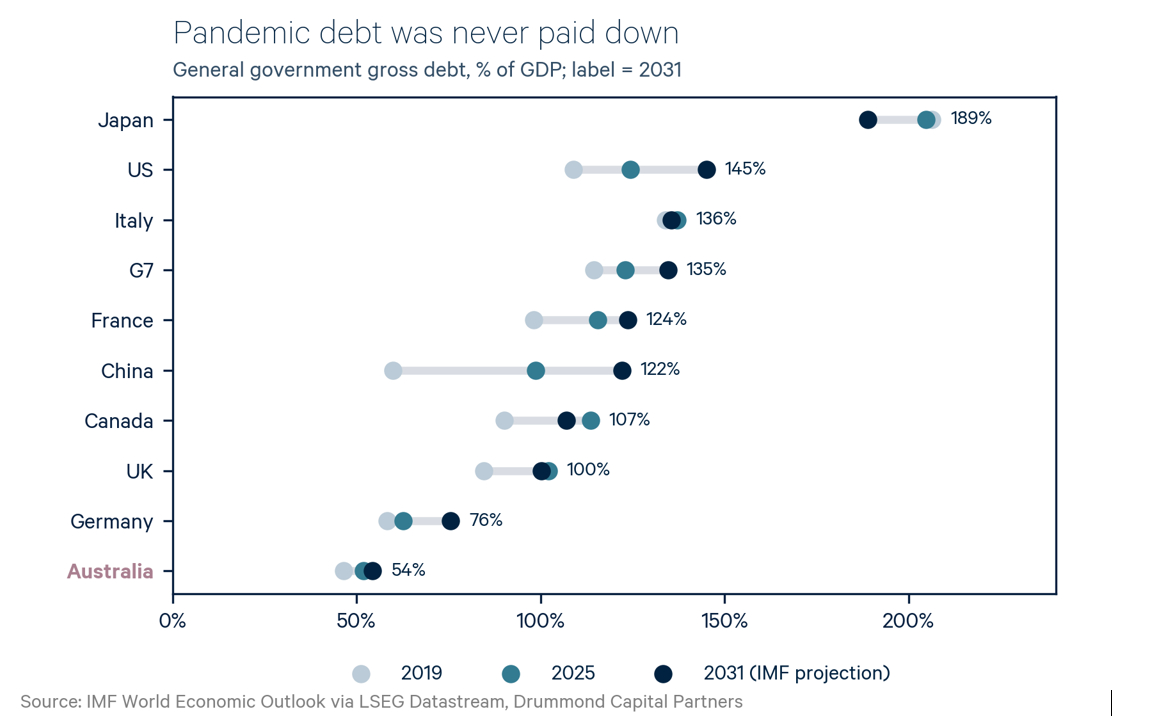
• Government debt in the major economies jumped during Covid, never returned to pre-Covid levels, and is projected to keep rising.
• These are recession deficits run at close to full employment driven by insufficient revenue to fund promises (USA) or open-ended spending commitments that are now out of control (UK, France and Australia).
• With interest rates now broadly normalised, interest payments are a meaningful portion of government spending.
• Reform is possible, but social media and fragmented politics make it tough. We think it is more likely to be forced by bond markets than chosen by governments, and long-term yields may be reflecting that.
Benjamin Franklin famously wrote that nothing in this world is certain except death and taxes. We can now add government debt to the list. For a long time unsustainable fiscal paths didn't matter much. Interest rates were low, inflation was lower, and investors were so scared of a Financial Crisis repeat they were happy to hold bonds with negative expected returns. That world has gone. Long-term government bond yields have risen between 40 and 130 basis points across major markets this year, and are hundreds of basis points higher than the post Financial Crisis period. Investors now demand some compensation for lending to governments.
In this month's Market Insight, we look at the state of government finances across the major economies and Australia. Is there a point at which debt simply can't be serviced? Can governments still fix it in a world of social media? And what does it mean for bonds?
Nobody Paid It Back
Whether you agree or not that shutting down the economy in Covid was the right call, the fiscal response to the shutdown was required to prevent a cataclysmic recession. The problem is that debt never returned to pre-Covid levels and is expected to rise further still in the years ahead (see below).
In an ideal world, governments run deficits in recessions and repair the damage in the good years. Ideal being the operative word there. The inclination of most governments, like most of the people they represent, is to happily spend other people’s money without much consideration.
Labour markets are healthy across most of the developed world, yet the US is projected to run a deficit of around 8% of GDP every year between 2026 and 2031. The G7 as a whole runs around 6% and is projected to rise by around 3 percentage points of GDP between 2019 and 2031, while revenue rises by about half a point. Spending has completely outrun the tax base.
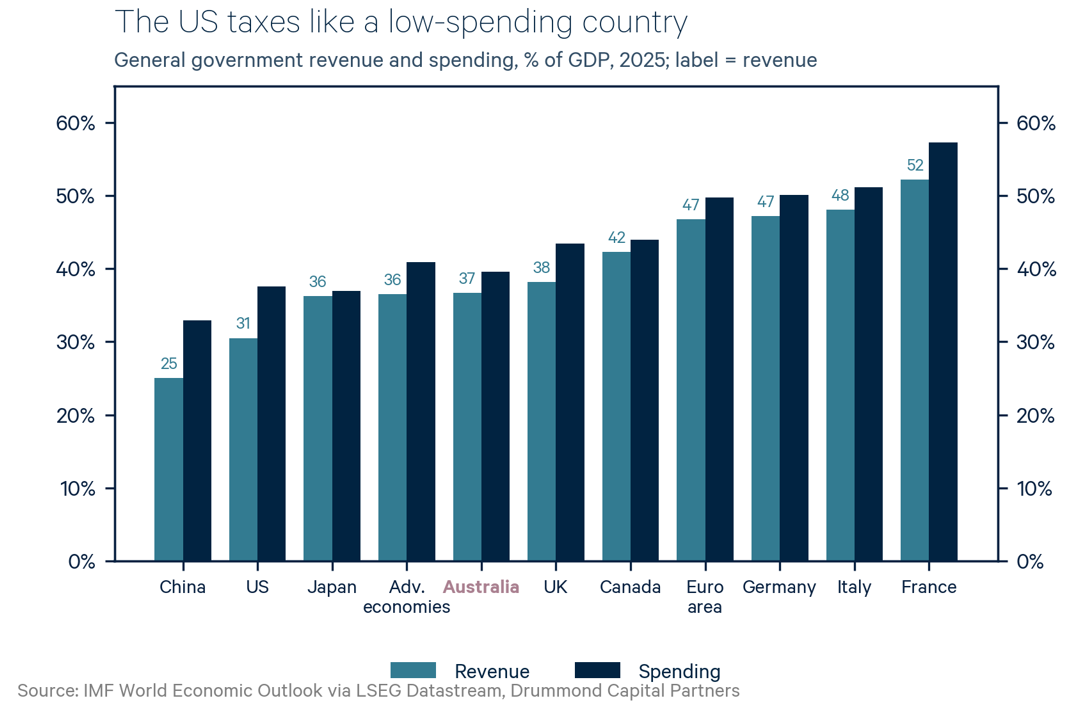
The US is an outlier on the deficit because it’s an outlier on taxation. US governments (federal, state and local together) collect around 31% of GDP in revenue, against roughly 37% in Australia and 47% across the euro area (see below). US government spending, at around 38% of GDP, is actually below most of its peers, partly because Americans pay for much of their healthcare privately rather than through taxes. If the US collected the advanced economy average of around 36.5% of GDP, its 2025 deficit would have been closer to 1% than 7%. Europe has the opposite problem. France already collects more than half of its GDP in revenue, among the highest in the world, and still runs a deficit of around 5%. There isn't much left to squeeze from the tax side, which leaves spending, and that is where things get difficult.
Promises, Promises
Much of the growth in spending isn't the result of any deliberate decision. It is the slow compounding of promises that are easy to make, hard to cap and almost impossible to wind back. Ageing populations drive the big items, pensions and health. But the more revealing examples are smaller programs that have grown well beyond what anyone intended when they were introduced.
Take the UK's pension triple lock, which raises the state pension each year by the highest of wage growth, inflation or 2.5%. Taking the highest of three numbers every year is a ratchet: pensions can only ever gain ground on wages, never lose it. The Office for Budget Responsibility estimates it now costs around three times what was expected when it was introduced, roughly £15bn a year by the end of the decade. Or the Motability scheme, which lets recipients of disability mobility payments exchange them for a leased car, and now accounts for around one in five new cars sold in the UK. When the government tried to trim disability benefits last year, a backbench revolt forced it to abandon most of the savings within weeks.
Australia has its own version. The National Disability Insurance Scheme (NDIS) was originally expected to cost around $22bn a year once fully rolled out. It now costs around $54bn, more than Medicare. The original target of slowing its growth to 8% a year has since been tightened by National Cabinet to 5 to 6% a year or lower, which would still see it grow faster than the economy and we are sceptical it can be achieved. As we have noted before, every excess NDIS worker is a missing childcare worker, teacher's aide or aged care worker.
None of these programs is foolish in intent. Supporting disabled people and pensioners is a perfectly reasonable thing for a rich country to do. The problem is design. They are open-ended entitlements, indexed generously, with eligibility that drifts wider over time and no natural brake. And every one of them has a large, organised and sympathetic constituency, which makes them very hard to reform, as we discuss below.
The Snowball
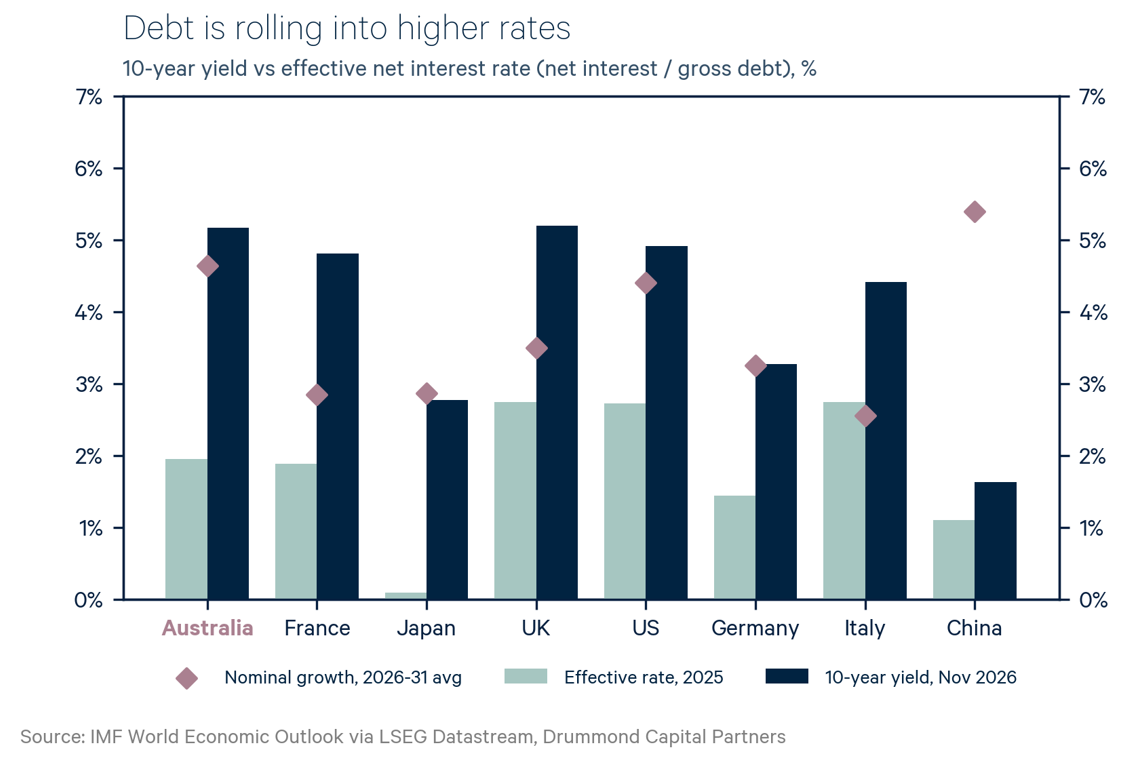
Whether a debt load is sustainable comes down to two numbers: the interest rate paid on the debt and the growth rate of the economy (in nominal terms, including inflation). When growth outruns interest, a government can run a modest primary deficit and still see its debt shrink relative to the economy. When interest outruns growth, the debt compounds on itself like a snowball rolling downhill, and the government needs a primary surplus just to stand still. For most of the past fifteen years, governments enjoyed the first situation. Rates were near zero after the Financial Crisis, and the inflation spike of 2021 and 2022 lifted nominal GDP while the average rate on existing debt barely moved. Inflation did a lot of fiscal repair.
The good times have passed. The average rate governments pay on their debt is still low because much of it was issued when yields were near zero. Every bond that matures is refinanced at today's higher yields (see below). Government interest bills will keep rising for years even if nothing else changes. In the UK, France and Italy, 10-year yields are now around 2% above the IMF's projections for nominal growth, which is snowball territory. On our numbers, the US would need to improve its primary balance by around 2.7% of GDP just to stop its debt ratio rising. Germany would need about 2%, France a little over 1%, and Australia less than 0.50%.
Is There a Breaking Point?
So where does that leave fiscal credibility? What matters is who you owe, in what currency, and how the interest rate compares with growth. As we noted above, once interest runs above growth and a primary deficit persists, there is no natural ceiling on debt.
To illustrate, we projected debt out to 2060, taking the IMF's numbers to 2031 and assuming nothing changes after that, except that the rate paid on debt drifts up to today's bond yields as old debt matures. On that basis, US debt reaches around 260% of GDP and is still climbing. Other countries generally rise, but fare better. In reality, most projections actually suggest government spending will need to rise beyond these numbers given ageing populations.
At some point the problem will become big enough that change is forced. The chart below shows the net interest projection. In 1993, Italy was spending around a quarter of its revenue on interest, in the aftermath of the currency crisis that forced the lira out of the European exchange rate mechanism and into years of budget repair. Canada peaked at around 13% in 1995, the year it launched one of the deepest spending cuts of any developed economy. The US spent 10% of its revenue on net interest in 2025, and the IMF has that averaging over 14% for the rest of the decade. On our projection it passes Canada's 1995 level in 2028 and Italy's 1993 level in the late 2040s.
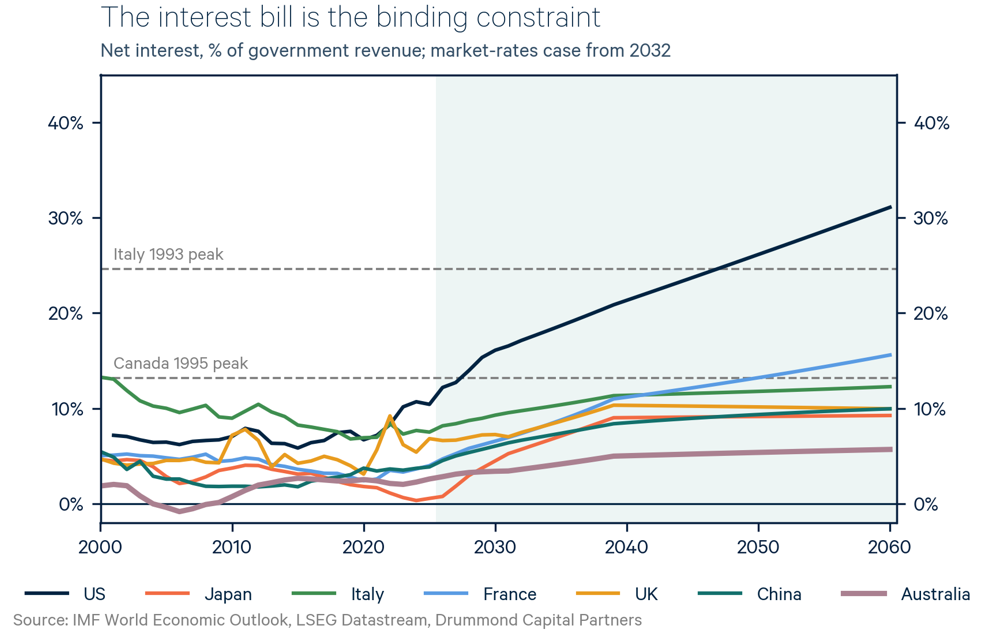
What gives is rarely an outright default for a country borrowing in its own currency. It can always print the money. The more likely outcomes are some mix of higher taxes, spending cuts, higher inflation and financial repression (keeping bond yields below inflation, often by requiring banks and pension funds to hold government debt). None of these are good for bonds.
Can Anyone Say No?
The economics of fiscal repair is simple, but painful. The politics is much harder. The benefits of any program are concentrated on the people who receive it, while the costs are spread thinly across everyone else. A 10% cut to a pension is a catastrophe for the pensioner and a rounding error for the taxpayer, so the pensioner campaigns and the taxpayer doesn't notice. That has always been true. However, social media may exacerbate the problem. Every angry pensioner or student or union representative can jump on their phone, record factually incorrect nonsense, and reach thousands, or millions, of eyes. Algorithms don’t reward nuance, and nobody has ever gone viral explaining the intertemporal budget constraint.
Politics has fragmented too. Insurgent parties, Reform UK in Britain and One Nation here, are eating into the major parties' vote, which makes any government with a thin majority even less willing to pick a fight with a large group of voters. France shows where this leads. Its 2023 pension reform, which raised the retirement age from 62 to 64, had to be forced through parliament without a vote, triggered months of protests, and was suspended last year as the price of keeping a government alive. The UK welfare episode followed the same script in a matter of weeks.
So, is reform even possible? Canada's deep spending cuts in 1995 came after the Wall Street Journal called it an honorary member of the third world. Sweden's consolidation followed a banking crisis in the early 1990s, and Italy's followed the lira's ejection from the European exchange rate mechanism. Australia's own reform eras in the 1980s and 1990s came with a dollar crisis and a 'banana republic' warning attached. The UK learnt in 2022 how quickly a gilt market can veto a budget. We expect more of that sort of thing in the future.
Bond markets seem increasingly sceptical governments will improve their balance sheets without a push. The Fed's policy rate is still 1.5% below its September 2024 level, even after September's hike, yet the US 10-year yield is up around 1.25% over the same period, and the 30-year more than that. Investors are demanding more compensation (term premium) for lending to governments for long periods. Part of this year's rise is an inflation story, with higher energy prices pushing the Fed and the RBA back into hiking. But long-term yields were rising even while central banks were cutting, which points to fiscal risk as a separate and more durable source of pressure.
For once, Australia stands out in a good way. Gross government debt (including the states) is around 52% of GDP, half the advanced economy average. Nominal growth is projected at around 4.6% a year against an average interest rate of around 2%, so the snowball runs in our favour. Even if we stress the numbers a bit, with higher rates and bigger deficits, Australia has enough headroom to be fine.
That said, we shouldn't get too smug. Australia's governments, federal and state combined, have run a deficit every year since 2008, and the favourable position is more about the starting point (low debt) than the current situation. We have a structural deficit in a country that can easily afford it, which is precisely why there is little pressure to fix it. And we are price takers in global bond markets. Australian 10-year yields are among the highest in the developed world, partly because of the RBA's renewed hiking cycle and partly because long-term rates are set globally. Australia has the balance sheet of a AAA borrower and, at the long end, the borrowing costs of a country with problems.
Portfolio Positioning
Government debt problems tend to build slowly and then surface quickly. We don't think a sovereign debt crisis in a major economy is imminent, and the US in particular benefits from issuing the world's reserve asset. However, the arithmetic has turned against borrowers for the first time in a generation, deficits are not closing, and we see little sign that governments will close them voluntarily. The supply of long-dated government bonds will keep growing. In that environment we expect investors to keep demanding a higher term premium, which limits how far long-term yields can fall even when central banks cut.
That said, the repricing of yields higher does make them look more attractive from a portfolio construction perspective. They offer a government guaranteed nominal return, although that is no protection against the inflation and financial repression we think are the more likely ways out. In a serious growth shock they should still perform relatively well, but with deficits already large, a recession could add to supply concerns and blunt the usual rally. We are currently strongly underweight government bonds, but they are looking more attractive as yields grind higher. Within the asset class, we prefer Australian government bonds to global sovereigns. They offer some of the highest yields in the developed world, backed by one of its strongest balance sheets.
Prepared by Drummond Capital Partners (Drummond) ABN 15 622 660 182, AFSL 534213. It is exclusively for use for Drummond clients and should not be relied on for any other person. Any advice or information contained in this report is limited to General Advice for Wholesale clients only.
The information, opinions, estimates and forecasts contained are current at the time of this document and are subject to change without prior notification. This information is not considered a recommendation to purchase, sell or hold any financial product. The information in this document does not take account of your objectives, financial situation or needs. Before acting on this information recipients should consider whether it is appropriate to their situation. We recommend obtaining personal financial, legal and taxation advice before making any financial investment decision. To the extent permitted by law, Drummond does not accept responsibility for errors or misstatements of any nature, irrespective of how these may arise, nor will it be liable for any loss or damage suffered as a result of any reliance on the information included in this document. Past performance is not a reliable indicator of future performance.
This report is based on information obtained from sources believed to be reliable, we do not make any representation or warranty that it is accurate, complete or up to date. Any opinions contained herein are reasonably held at the time of completion and are subject to change without notice.


