
Key Points:
• Global equities have had a strong 2026, driven by exceptional earnings growth that is the broadest since the post-Covid recovery in 2021.
• AI hardware leads the way, but the median stock outside technology is still expected to grow earnings by 11%, and every sector is in positive territory.
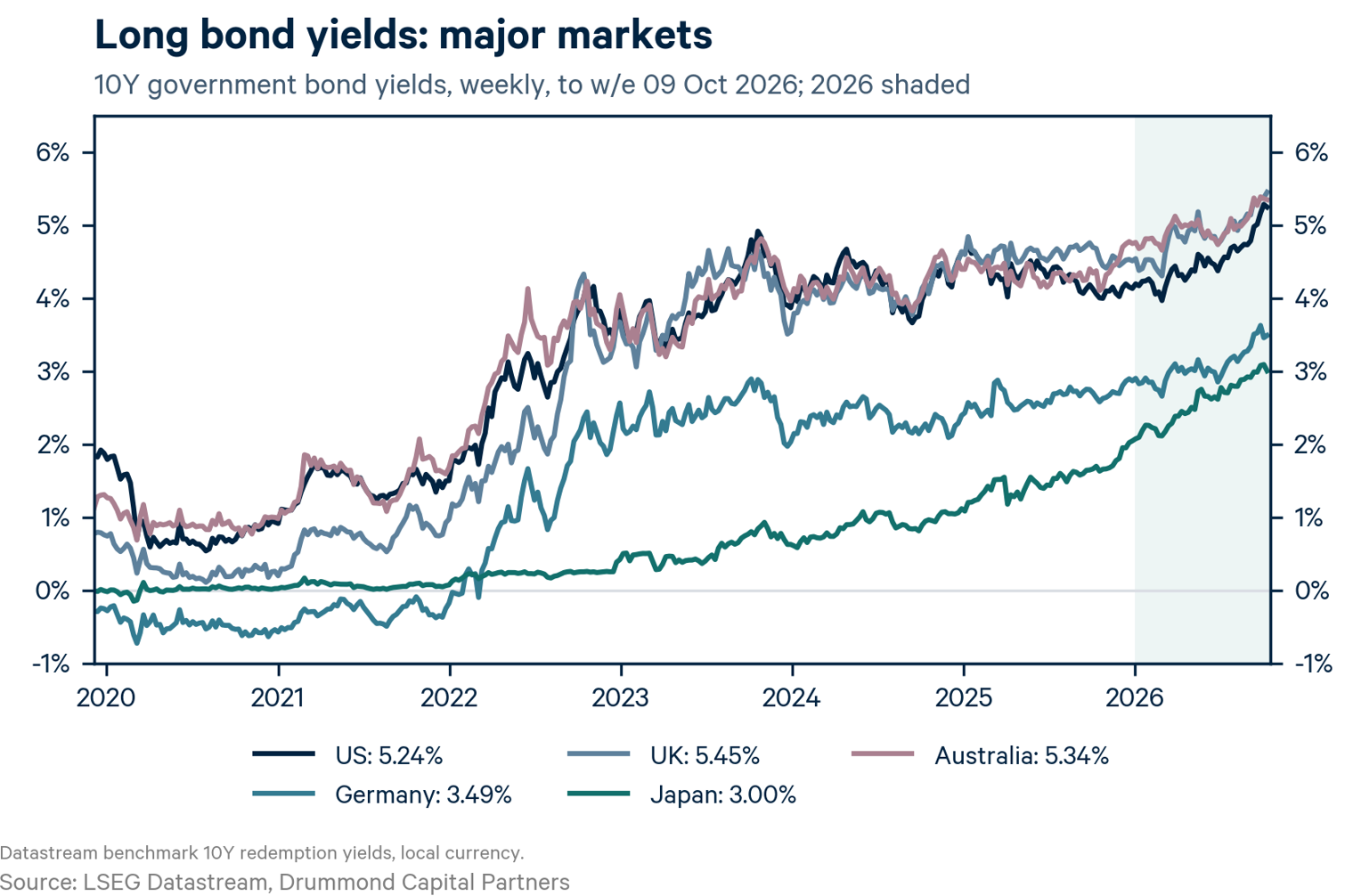
• Prices haven’t kept pace. Around 60% of the top 1000 global stocks have de-rated this year, most likely reflecting a 60–110bp rise in long-term bond yields across major markets.
• Valuations look reasonable relative to earnings but stretched relative to book value. Whether that gap closes rests on earnings, and in particular on AI capex, which is increasingly being funded with debt.
2026 has so far been an interesting year for markets. Global and emerging market equities have performed exceptionally well, supported by spectacular earnings growth. Bond yields have risen sharply, as strong economic growth and persistent inflation have kicked off a renewed interest rate hiking cycle. Energy prices remain elevated given no real resolution to the Iran War, though significant inventory drawdown and alternative routing paths have gone a long way to offset disruption in the Strait of Hormuz. Australian equities haven’t seen anywhere near the earnings growth of global equities and have therefore underperformed in a weakening domestic growth environment. Property and infrastructure have had an even worse ride, being more sensitive to higher interest rates than domestic equities.
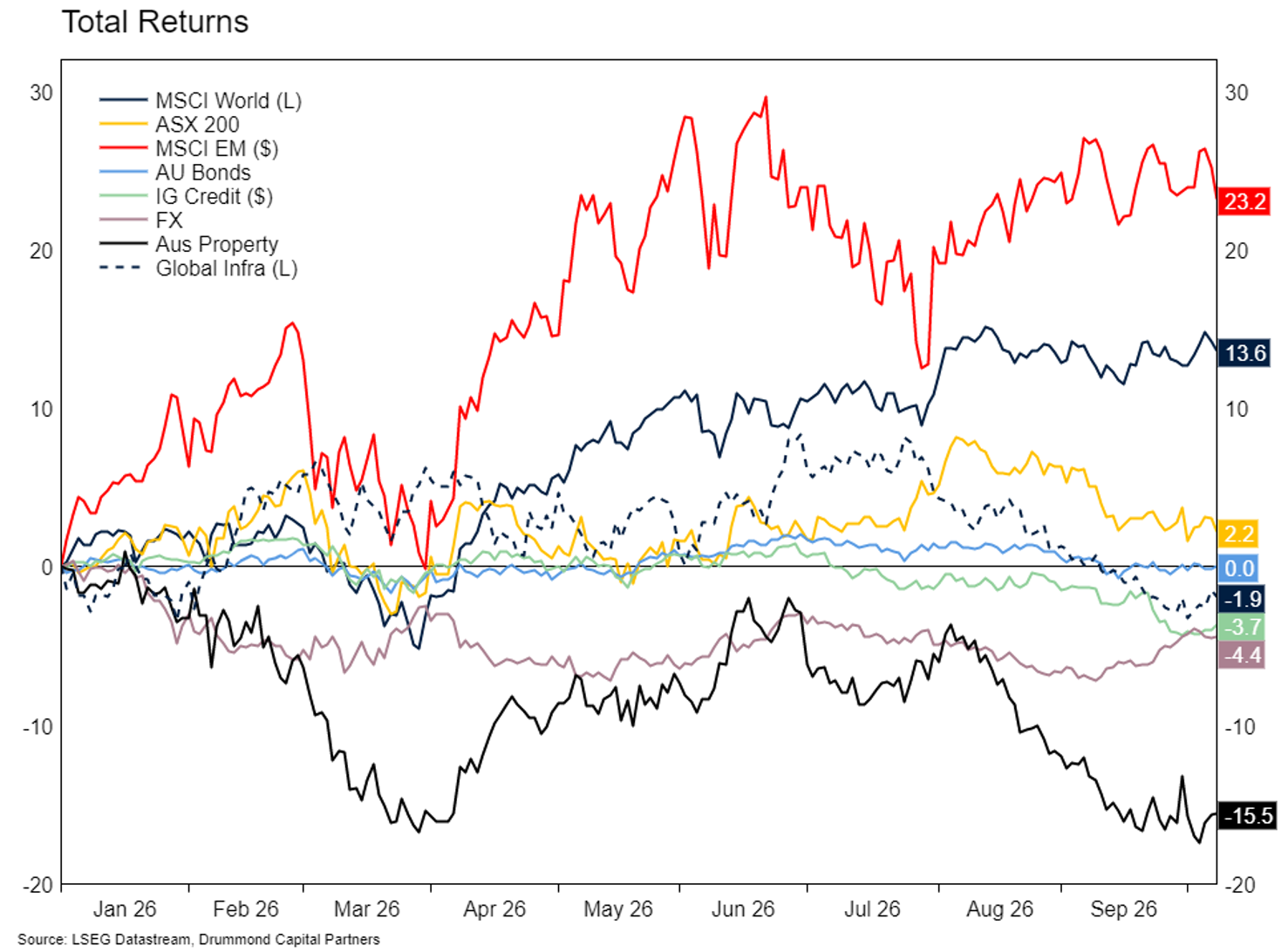
In this month’s Market Insight, we review global equity performance this year and provide our outlook for the year ahead. A lot rides on the persistence of the global earnings cycle.
Driven by Earnings
Markets were very happy this year to look through spikes in energy prices and higher interest rates because all bad news was overshadowed by earnings growth. At the moment, consensus expects over an 80% rise in earnings over the next year in emerging markets, more than 50% in the Nasdaq and around 40% in the S&P 500. Outside of recession recoveries, those numbers are bonkers. At the headline level, they are very clearly being driven by the AI ecosystem. Hardware shortages have seen incredible memory price spikes and cloud compute revenue growth remains very healthy.
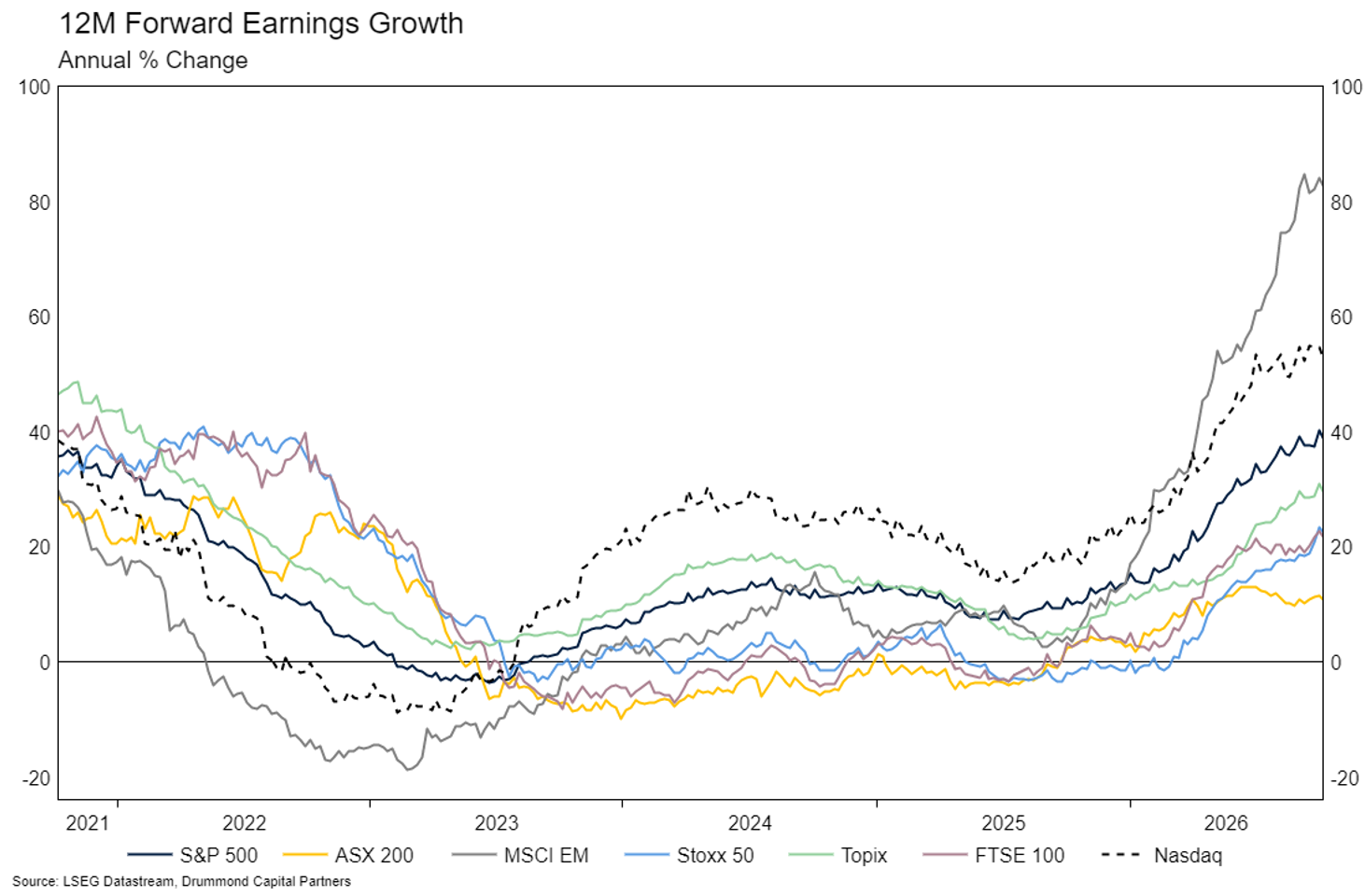
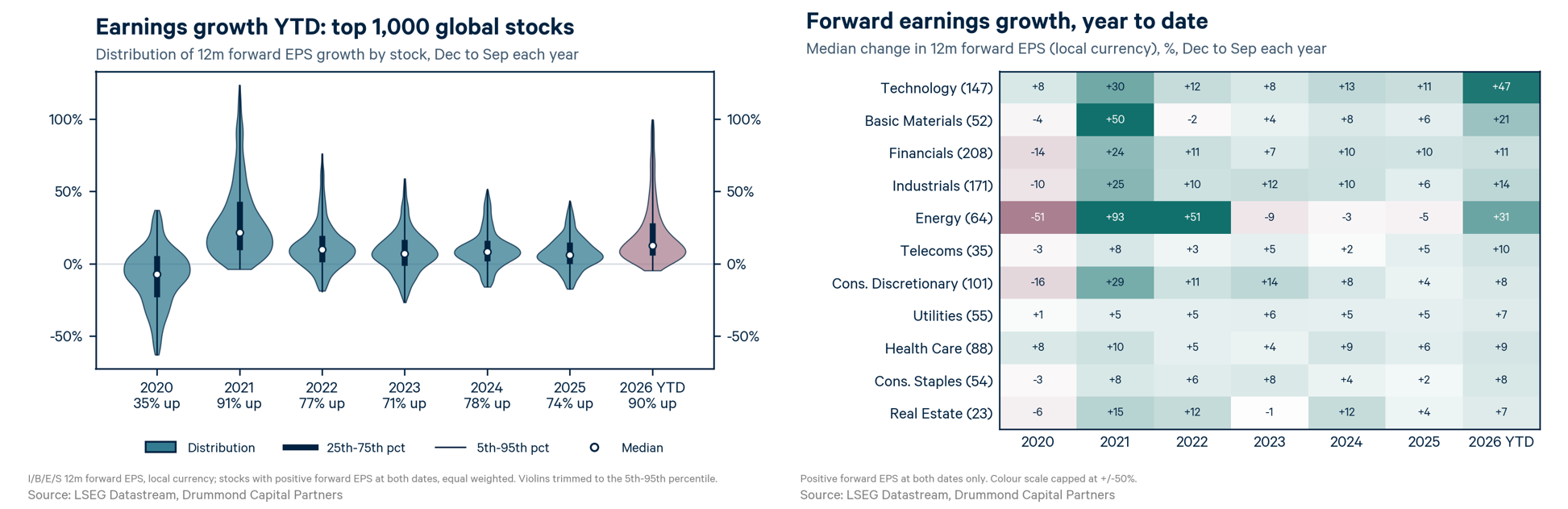
While this earnings growth has been mostly AI, other sectors have been holding their own. Indeed, forward earnings growth in global equities is expected to be the broadest since the Covid recovery in 2021. The chart below shows the distribution of expected earnings growth in the top 1000 global stocks each year since 2020. So far this year, 90% of these names are expected to see higher earnings in the year ahead. The median stock is expected to see 12.6%, compared with an average rise of 7.9% between 2022 and 2025. The very pointy end of the distribution is expected to see ~100% earnings growth, and that’s mainly the AI hardware names. Three-quarters of top 1000 companies are expected to have earnings growth of around 6% or more, compared with an average of 0.5% for that threshold between 2022 and 2025.
Technology stands out amongst the pack here, with the median stock expected to grow earnings by 47% on the back of an extraordinary upswing in memory and AI hardware. However, other sectors are also performing better than normal. Excluding technology, the median stock is still expected to grow earnings by 11%, and every sector is in positive territory. The fireworks at the top have masked a really solid outcome across the board.
Valuations
The market seems sceptical. Prices haven’t kept pace. The median stock is up 10% this year (to September), behind both 2024 (15%) and 2025 (13%) despite much stronger earnings growth, and prices have lagged earnings for around 60% of stocks, compared with roughly a third in each of the previous two years. The dispersion of weekly stock returns in the top 1000 names has also been higher than usual. The combination of strong earnings growth and more modest price growth has seen the median stock de-rate from a forward PE perspective so far this year. The forward PE of around 60% of the top 1000 stocks has fallen so far this year, a remarkable outcome when the MSCI World index is up 13.6%. It makes sense for AI hardware names to de-rate versus forward earnings given the earnings growth has been driven by supply shortages in what is typically a pretty cyclical industry. It makes less sense for the median stock to de-rate in an environment of increasing earnings growth. The latter probably reflects the impact of higher long-term interest rates.
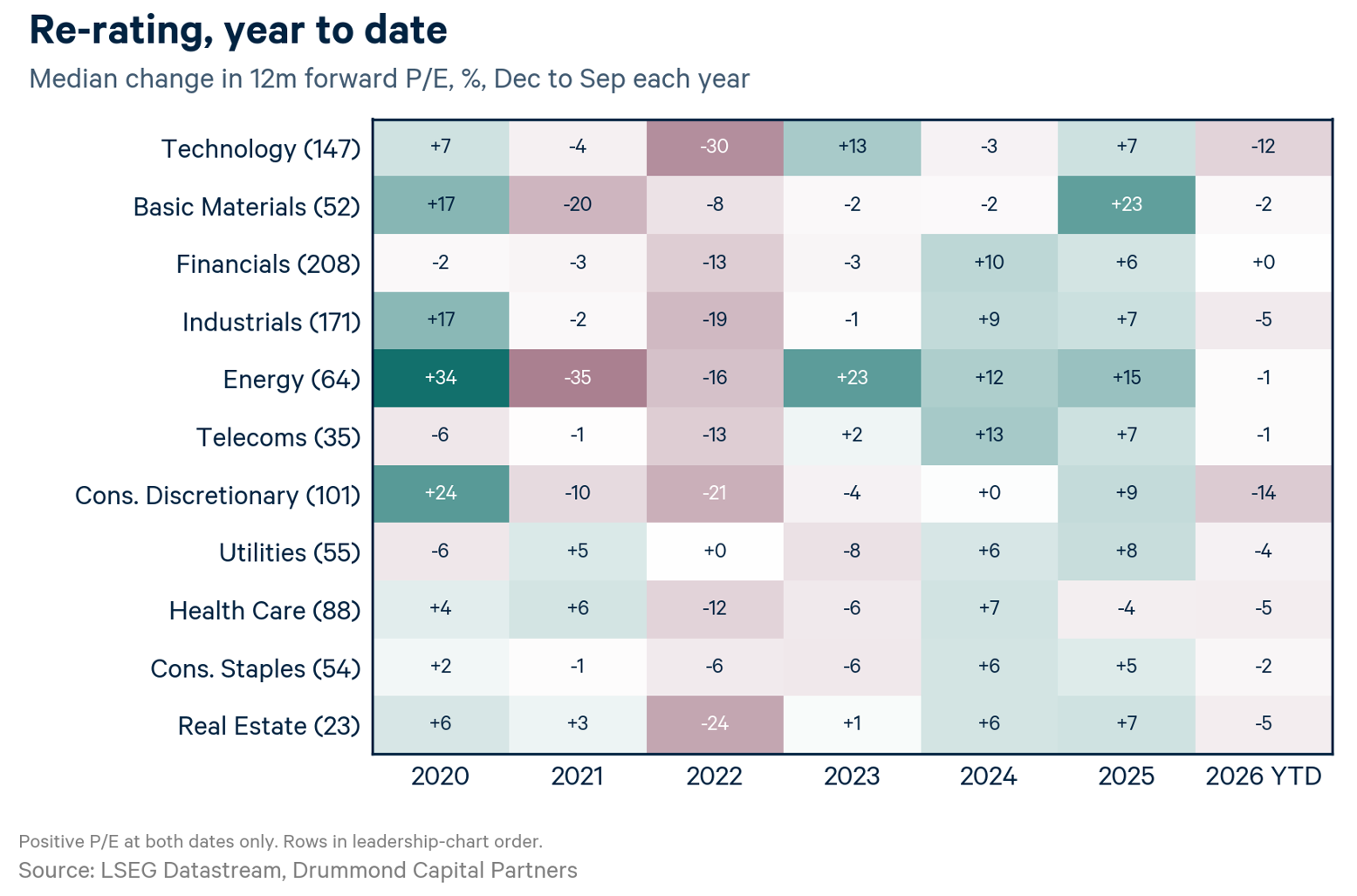
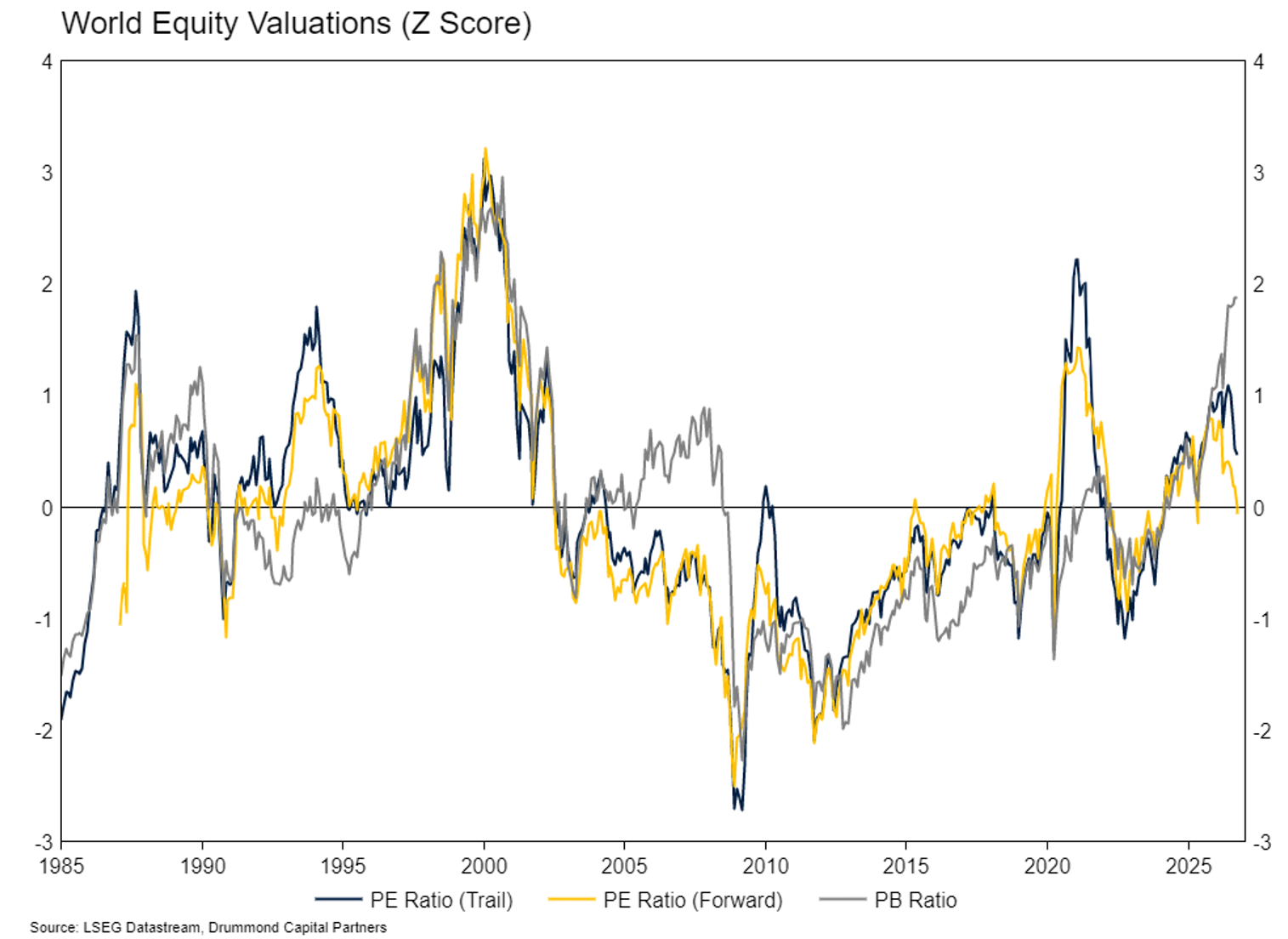
Overall, market valuations relative to forward and trailing earnings have improved meaningfully this year (see below). However, valuations relative to book value remain very elevated. Ultimately, it’s a question of earnings sustainability. When there have been big gaps previously between earnings and book valuations, they have been restored via sharp falls in earnings, typically associated with a recession. Perhaps this time will be different, but that comes down to earnings, and the biggest swing factor is the AI capex build.
The five hyperscalers (Microsoft, Amazon, Alphabet, Meta and Oracle) are expected to spend close to US$1 trillion on capex over the next twelve months, roughly double what was expected a year ago, and those plans are still being revised higher by around 20% a quarter. Chips, memory, semiconductor equipment, networking, servers and power have delivered much of this year’s earnings growth, and continued growth relies on spending continuing to rise. Between 2013 and 2024, the hyperscalers spent around one third of their operating cash flow on capex. Consensus now has them spending more than all of it (around 105%), with Oracle at more than one and a half times. From here, the build out is increasingly funded with debt, which makes it more sensitive to higher bond yields.
So far, there are no signs of cracks. Ahead of the last two big sell-offs in AI hardware stocks (late 2021 and early 2025), the share of analysts upgrading supplier earnings fell sharply while prices were still rising. At the moment, upgrades remain broad across every segment and supplier share prices are close to their highs relative to the world index. If capex plans do top out, hardware supplier earnings growth would obviously take a hit. In theory, this would be offset by growth in cloud compute revenue as the capex pays off. Either way, it’s not a 2027 problem given how much momentum is already baked into the build.
Where to From Here?
It seems likely that global economic growth, led by the USA, will be robust over the year ahead. The market expects more rate rises across the board, but we don’t think policy will tighten enough to have a very large impact on growth. Labour markets are healthy and productivity growth (potentially helped by AI adoption) is better than the post-Financial Crisis average. Overall growth is clearly also being supported by the AI capex build, which is widespread across economies.
Australia has a less rosy outlook, lacking the productivity growth of the US. Headline growth domestically is also likely to come under pressure due to lower population growth, with support for lower migration looking increasingly bipartisan. China’s economy outside of tech is also expected to remain sluggish as the housing market unwind continues to be digested.
Reasonable growth and a continuation of the AI capex build out suggests earnings growth should remain solid in the year ahead. Mechanically, some moderation in the AI hardware segment seems certain given the law of large numbers, but as the valuation charts above show, the market never believed those earnings could be maintained anyway. Some normalisation there, combined with a continued broadening in earnings across the rest of the world would look like a strong, healthy market. Whether broadening earnings growth makes it to prices will probably depend on long-term bond yields. The most likely reason median prices have lagged despite strong median earnings growth is that long-term bond yields have risen 60–110bp across major markets this year. If the sell-off in bonds is near complete, a moderate headwind to the market would be removed. Stable bond yields should also support REITs and infrastructure.
The geopolitical risks that dominated headlines earlier in the year look less important from here. Like most geopolitical shocks, the Middle East conflict has faded from markets outside energy. Oil export routes have adapted to disruption in the Strait of Hormuz, with a similar amount of oil leaving the Middle East now as before the conflict, and only a re-escalation that does lasting damage to oil infrastructure would change that. Some risk premium will persist until the conflict is fully resolved, and prices will stay bid while inventories are rebuilt. Nor do we think next month’s US midterm elections will matter much. The Democrats look almost certain to win the House and may take the Senate, which points to stalemate for the rest of President Trump’s term rather than anything market moving.
The bigger risks would be an inflation surprise that pushes central banks and long bond yields higher than expected, and any sign that the AI capex cycle is rolling over. On the latter, two things are worth watching. A meaningful share of datacentre funding is now coming through private credit and off-balance-sheet vehicles rather than hyperscaler balance sheets, so wider credit spreads or a pullback in private credit could force capex cuts even if AI demand holds up. And much of this year’s AI hardware earnings growth rests on shortages. As new memory and chip capacity comes online, shortage pricing will fade even if demand keeps growing.
There are also risks unique to Australia. The RBA is expected to tighten a little further into a slowing economy, and house prices are falling again following the investor tax changes in the Budget. As we noted last month, housing corrections in Australia have historically capped out at around 10%, and policymakers have plenty of levers to support the market. However, the combination of higher rates, the tax changes and growing political pressure to cut migration means the risk of a deeper fall is higher than usual. Given how much household wealth sits in real estate, even a moderate fall would weigh on spending and domestic earnings, which have already lagged global markets this year.
Portfolio Positioning
The surprise this year was exceptional earnings growth which let global equities sail through a somewhat rocky macro backdrop of oil shocks and higher rates. With growth looking pretty solid and the AI capex build unlikely to gap lower over the next 12 months, overall earnings should be robust, but unlikely to be as strong as this year. A continued broadening of earnings growth beyond tech would also be welcome. On that front, a lot hangs on where long-term bond yields settle. We think there may be a bit more to go on the sell-off, but don’t expect as much pain as this year.
In line with this, our portfolios are currently neutral on growth assets, with an underweight to Australian equities and an overweight to global equities. Within our global equities exposure, the manager mix is diversified across style and region, aiming to balance tech and non-tech exposure. Our portfolios are also underweight government bonds and overweight credit given the view of a little more pain on the bond front.
Prepared by Drummond Capital Partners (Drummond) ABN 15 622 660 182, AFSL 534213. It is exclusively for use for Drummond clients and should not be relied on for any other person. Any advice or information contained in this report is limited to General Advice for Wholesale clients only.
The information, opinions, estimates and forecasts contained are current at the time of this document and are subject to change without prior notification. This information is not considered a recommendation to purchase, sell or hold any financial product. The information in this document does not take account of your objectives, financial situation or needs. Before acting on this information recipients should consider whether it is appropriate to their situation. We recommend obtaining personal financial, legal and taxation advice before making any financial investment decision. To the extent permitted by law, Drummond does not accept responsibility for errors or misstatements of any nature, irrespective of how these may arise, nor will it be liable for any loss or damage suffered as a result of any reliance on the information included in this document. Past performance is not a reliable indicator of future performance.
This report is based on information obtained from sources believed to be reliable, we do not make any representation or warranty that it is accurate, complete or up to date. Any opinions contained herein are reasonably held at the time of completion and are subject to change without notice.


-p-500.png)